

M2 internship available in PERSING team
Published on 23 October 2025
A study of the neuromodulators involved in the emotional state of the honeybee
Host laboratories
Project supervisors
Background and Research Questions
Emotions influence the perception and interpretation of the environment.
This phenomenon, known as judgement bias, manifests itself, in particular, as a more optimistic or pessimistic interpretation of an ambiguous situation, depending on the individual’s emotional state.
Observed in many animal species, this bias offers a way to study emotional states in animals.
Honeybees (Apis mellifera) are the first invertebrates in which a judgement bias has been observed (Bateson et al., 2011; Schluns et al., 2016). However, the neurobiological mechanisms underlying this phenomenon remain largely unknown. Nevertheless, research suggests a link between neuromodulatory systems and variations in affective state. Their precise role in the expression of a pessimistic judgement bias in bees, however, remains to be determined.
Objectives of the internship
The aim of this internship is to identify the neuromodulatory systems involved in the pessimistic judgement bias in the honeybee.
Methodological Approaches
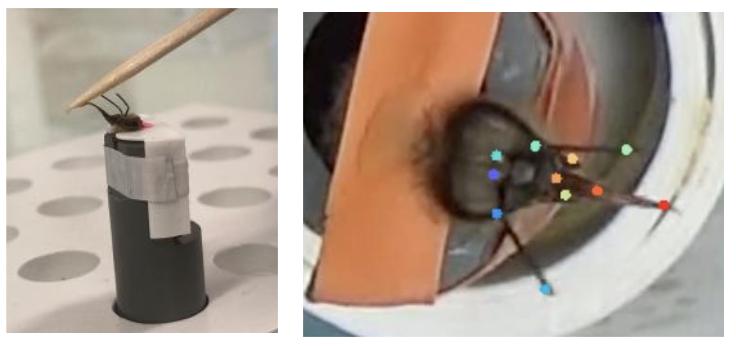
The internship will be based on a pre-established behavioural protocol, based on differential olfactory conditioning and the proboscis extension reflex (PER).
The student will carry out behavioural experiments coupled with a pharmacological approach, involving the delivery of agonists and antagonists targeting the dopaminergic, octopaminergic and serotonergic systems.
The effects of these treatments will be assessed through the bees’ responses during judgement bias tests and analysed retrospectively using DeepLabCut.
Desired Qualifications
The ideal candidate will be highly enthusiastic, communicative and meticulous, with a background in biology, ecology or ethology. An interest in behavioural ecology and/or neurophysiology would be a plus.
Applications must include, in a single PDF file, a CV (max. 1 page), a covering letter (max. 1 page), a copy of your first-year Master’s (M1) transcript, and contact details for at least one referee.
Contacts
Interested candidates are asked to contact Marco Paoli (marco.paoli@u-bourgogne.fr) and Léa Droesbeke-Fuente (lea_droesbeke-fuente@etu.ube.fr).
Related papers
Bateson et al. (2011) Agitated Honeybees Exhibit Pessimistic Cognitive Biases. Current Biology.
Schlüns et al. (2017) The Glass Is Not yet HalfEmpty: Agitation but Not Varroa Treatment Causes Cognitive Bias in Honey Bees. Animal Cognition