

The CSGA explores invisible worlds: a scientific journey into the heart of the microbiota
Published on 19 December 2025
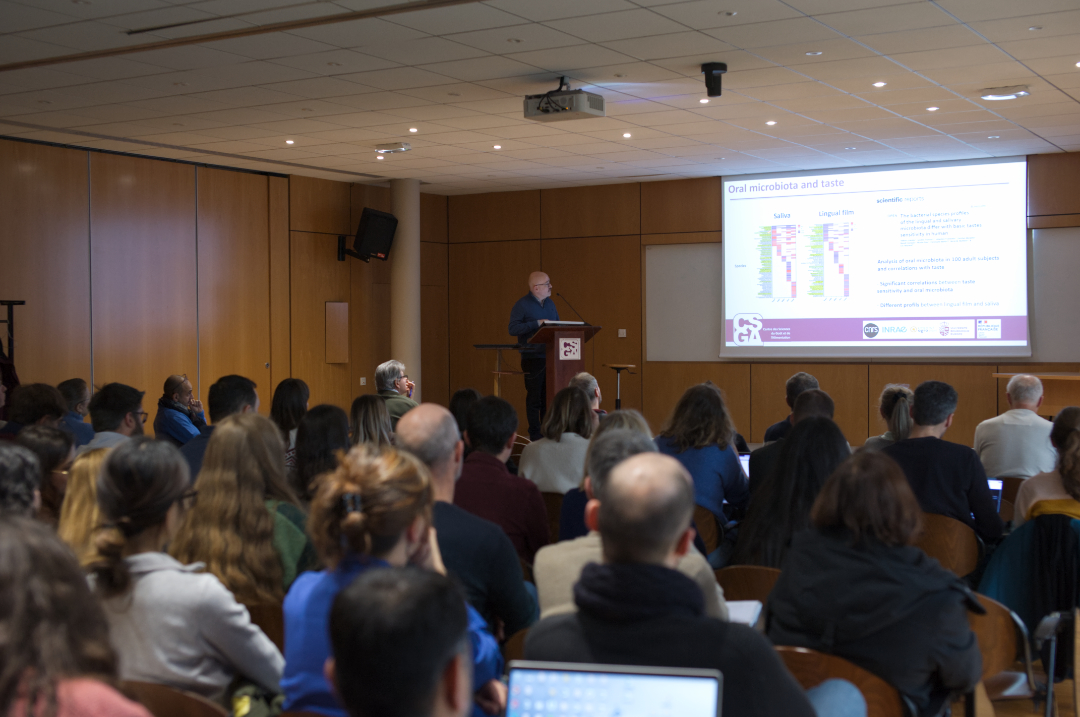
On 1 December 2025, CSGA researchers presented a series of studies exploring the often unsuspected role of the microbiota in perception, eating behaviours and health.
As December begins to slip away, more than 100 researchers, engineers, technicians and students have opened windows onto the infinitely small. Each presentation revealed a discovery, sometimes amusing, sometimes intriguing.
The first open window is the mouth, presented by Éric Neyraud. This is a space densely colonised by bacteria, viruses and yeasts. Some cling to the palate, while others prefer the tongue or teeth. There is almost a housing crisis because all the ecological niches are occupied! These micro-inhabitants are far from mere squatters: they influence our perception of flavours. So there's no point sticking out your tongue at them — they're very comfortable where they are.
Next, we move on to fruit flies - Drosophila - with Léo Sillon. We learn that the larvae love rotten fruit, a veritable breeding ground for microbes, while the adults are more discerning and prefer a ripe apple.
Next, Benoist Schaal reveals the habits of baby rabbits: between their single daily feedings, the newborns ingest their mother's faecal pellets, which she has taken care to scent with a volatile molecule, a pheromone, that is very attractive to her young. The aim? To establish a robust microbiota very quickly after birth, maximising their chances of survival.
Back to humans with Virginie Delannoy. As we age, we see a decrease in microbial diversity, which is often accompanied by dysbiosis, an imbalance between beneficial and less beneficial species. These changes are not only linked to biological age, they also depend on where we live. When an older person moves into a retirement home, the transition is also microbial, a process that is far from insignificant for the host's health.
Vision then enters the discussion thanks to Marie-Agnès Bringer. Gut microbiota could help to protect our retinas from Age-related Macular Degeneration (AMD) by modulating lipid metabolism and stimulating autophagy, the cellular 'internal cleaning' mechanism that appears to break down in patients. Prebiotics and probiotics therefore offer a promising way to support the balance of our gut microbiota. This shows that we should not overlook the microbiota if we want to keep our eyes sharp!
With Alexandre Bénani, it's time to focus on appetite regulation. His team has demonstrated that the microbiota influences our eating behaviour through its toxins and metabolites. Without the microbiota, the body struggles to control itself when faced with a high-calorie meal: satiety hormones collapse and appetite runs wild. In fact, this team's work has revealed a strong correlation between gut microbiota activity and brain activity in the hunger control centres.
Finally, Jordi Ballester returns us to the subject of vines and wine. After all, the festive season is approaching! To make wine, you need microbes, but not just any microbes. Sulphites have long been the guardians of the cellar, warding off the undesirable microbes that give wine unpleasant aromas.
Today, bio-protection, which consists of saturating the environment with beneficial yeasts, is an attractive alternative.
This first cross-disciplinary day on microbes at the CSGA ended with a discussion that opened new windows and prospects for collaboration between team.
Key words
Microbiota; sensory perception; development; metabolic disease; ageing; AMD; bioprotection
Contacts
Eric Neyrau: eric.neyraud@inrae.fr
Marie-Agnès Bringer : marie-agnes.bringer@inrae.fr
For more informations
Ben Fradj S, Nédélec E, Salvi J, Fouesnard M, Huillet M et al. (2022). Evidence for constitutive microbiota-dependent short-term control of food intake in mice: Is there a link with inflammation, oxidative stress, endotoxemia, and Glp-1? Antioxidants and Redox Signaling, 37, 349-369.
Fouesnard M, Zoppi J, Petera M, Le Gleau L, Migné C, Devime F et al. (2020). Dietary switch to Western diet induces hypothalamic adaptation associated with gut microbiota dysbiosis in rats. International Association for the Study of Obesity, 45, 1271-1283.
Ibarlucea-Jerez M, Monnoye M, Chambon C, Gérard P, Licandro H, Neyraud E. Fermented food consumption modulates the oral microbiota (2024). Science of Food, 8,55
Lapaquette P, Boucard AS, Chain F, Grégoire S, Bermúdez-Humarán LG, Acar N, Bringer MA (2023). Time-restricted feeding potentiates the ability of Lacticaseibacillus casei to enrich the retina in omega-3 fatty acids. Aging and disease, 14, 1945-1949.
Schaal B, Moncomble A.S., Langlois D (2023). Does the rabbit mammary pheromone attract newborns to maternal faeces? A new potential function of the suckling chemosignal. In Schaal B, Rekow D, Keller M & Damon F (eds.), Chemical Signals in Vertebrates, Volume 15 (pp. 331-359). Springer Nature, Chams, Switzerland.
Author
Claire Sulmont-Rossé , ANICOM