

PERSING team Guest Scientific Seminar
Published on 03 November 2026
Speaker
Enrico BERTOLINI
Enrico’s seminar will be held on 3 December and will begin at 2.00 pm in the CSGA conference room.
There will be an opportunity for Enrico to chat with the unit’s staff over tea or coffee and biscuits.
Short bio
Enrico studied molecular biology at the University of Padua (Italy) and completed his master’s thesis in the lab of Bambos Kyriacou at the University of Leicester (UK), investigating Drosophila reproductive diapause.
He then did a PhD at the University of Würzburg (Germany) in the lab of Charlotte Förster, studying the evolution of circadian clocks and photoperiodism in insects.
For his postdoc, he moved to Switzerland joining the lab of Thomas Auer tostudy the evolution taste and feeding in Drosophila sechellia.
He is currently a guest researcher in theDessmoz/Glover group at the Swiss Institute of Bioinformatics working on the phylogeneticprofiling of insect neuropeptides.
Talk title
Time, taste and leks: studying behavioural evolution across flies
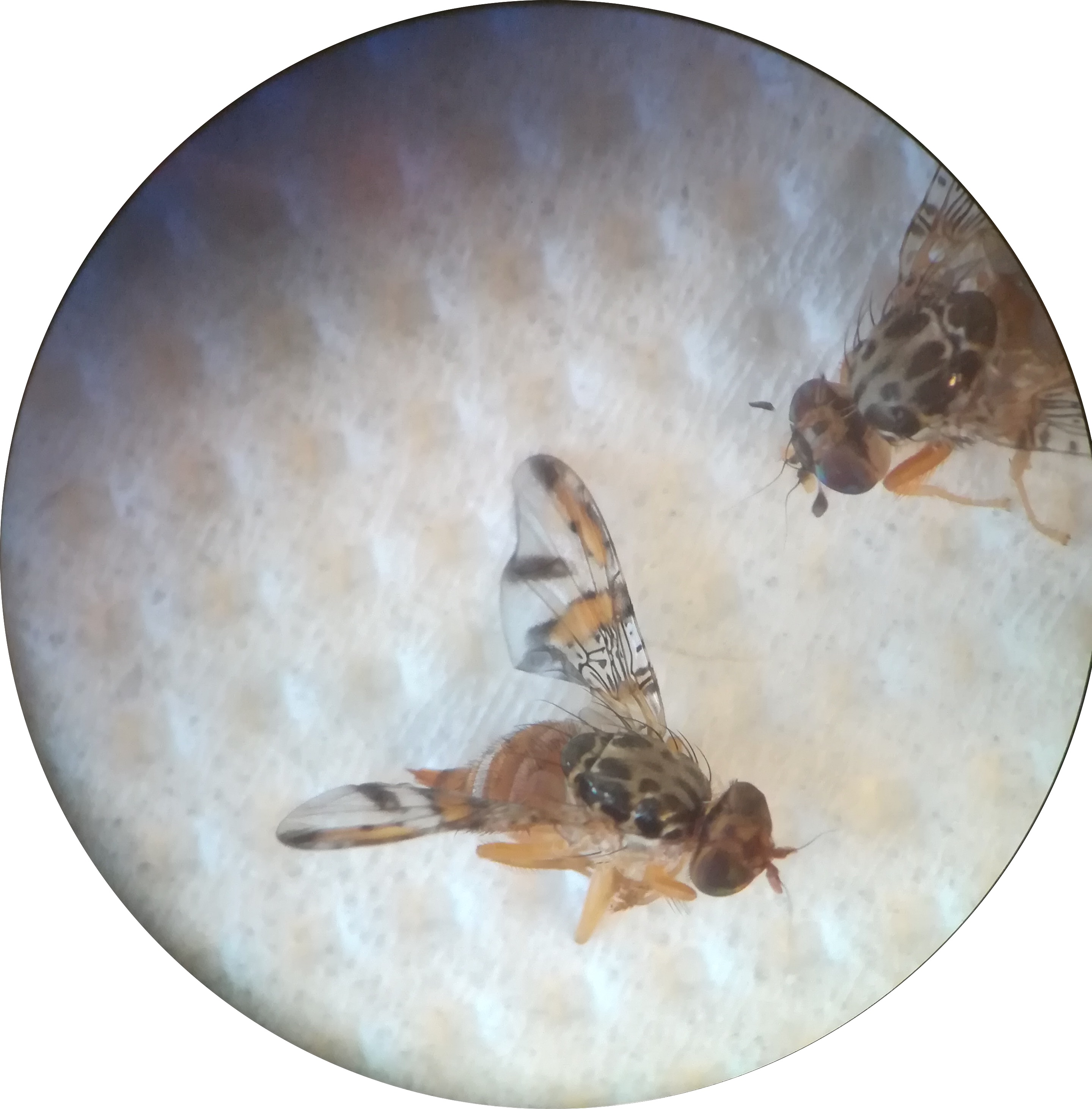
The Medfly, Ceratitis capitata.
Fruit pest (citrus fruit, peaches mostly)
Summary
Behaviour can diverge rapidly between closely related species as they adapt to new eco-logical niches, but we still know little about how evolution reshapes the nervous system to produce these changes.
Viewed the other way, behavioural differences between species can be exploited to uncover core principles of neurobiology.
In this seminar Enrico will trace his path through the evolution of fly behaviours, from northern flies that cope with extreme photoperiods, to tropical island species that specialized on the vomit fruit, to agricultural pests with elaborate collective mating rituals.
His work bridges neurobiology, ecology and evolution, turning ecologically interesting flies into tractable laboratory models to understand how behaviour evolves.
Key words
Behaviour, model flies, pest flies
References
• Bertolini, E., Münch, D., Pascual, J., Sgammeglia, N., Bruzzone, M., Ribeiro, C., & Auer, T. O.(2026). Evolution of taste processing shifts dietary preference. Nature, 649(8097), 657–666
• Reinhard, N., Bertolini, E., Kuwahara, T., Sekiguchi, M., Rieger, D., Li, W., Taghert, P. H.,Yoshii, T., & Helfrich-Förster, C. (2025). A functional clock in only two dorsal clock neurons issufficient to restore the basal circadian activity pattern of Drosophila melanogaster. PNAS, 122(44), e2506164122
• Dürr, B. R., Bertolini*, E., Takagi*, S., Pascual*, J., Abuin, L., Lucarelli, G., Benton, R., &Auer, T. O. (2025). Olfactory projection neuron rewiring in the brain of an ecological specialist. Cell Reports, 44(5), 115615
• Bertolini, E., Schubert, F. K., Zanini, D., Sehadová, H., Helfrich-Förster, C., & Menegazzi, P.(2019). Life at high latitudes does not require circadian behavioral rhythmicity under constantdarkness. Current Biology, 29(22), 3928–3936.e3
• Bertolini*, E., Kistenpfennig*, C. R., Menegazzi, P., Keller, A., Koukidou, M., &Helfrich-Förster, C. (2018). The characterization of the circadian clock in the olive flyBactrocera oleae (Diptera: Tephritidae) reveals a Drosophila-like organization. Scientific Reports, 8(816)
* = equal contribution